
On Unhad Conversations
Tragedy at the Donation Table

When I first moved to Albuquerque, I often ran across an older gentleman who sat in the lobby of my apartment building—or sometimes on the bench just outside the entrance. He was there nearly every time I walked in through or left by the main lobby. He looked like a kind old man, and was of that vague descent that many New Mexicans appear to share: an inscrutable mixture of Caucasian, Latin American, and Native. The man always smiled sweetly at me and would mumble a short, simple greeting that I often did not understand. I would sometimes find him there late at night, asleep and slumped over in one of the chairs with his cane in his lap. I never heard him snore. He never looked lonely, despite never seeing anyone talk to him beyond the universal head nod of a greeting.
I always meant to talk to him—to one day sit down, and ask him, “why are you always sitting here?”
I never did.
And I never will.
I am uncertain how common of an occurrence this is, but my apartment building has a table where people throw their unwanted things that (usually) aren’t trash. My landlady vaguely referred to it as the “donation table” and mentioned when I moved in ten months ago that she wanted to not just have it be a table in the center entrance because it looked tacky. (She’s not acted on that plan.) Every thing found on that table is free to grab. I often see food or cooking supplies on the table. I once grabbed seven reams of paper of various colors, which was literally a heavy burden to transport to my third floor apartment. I regret not grabbing the free TV which I would’ve used as a second monitor for my computer. People place kid’s games, movies, religious literature, and random knickknacks onto that table.
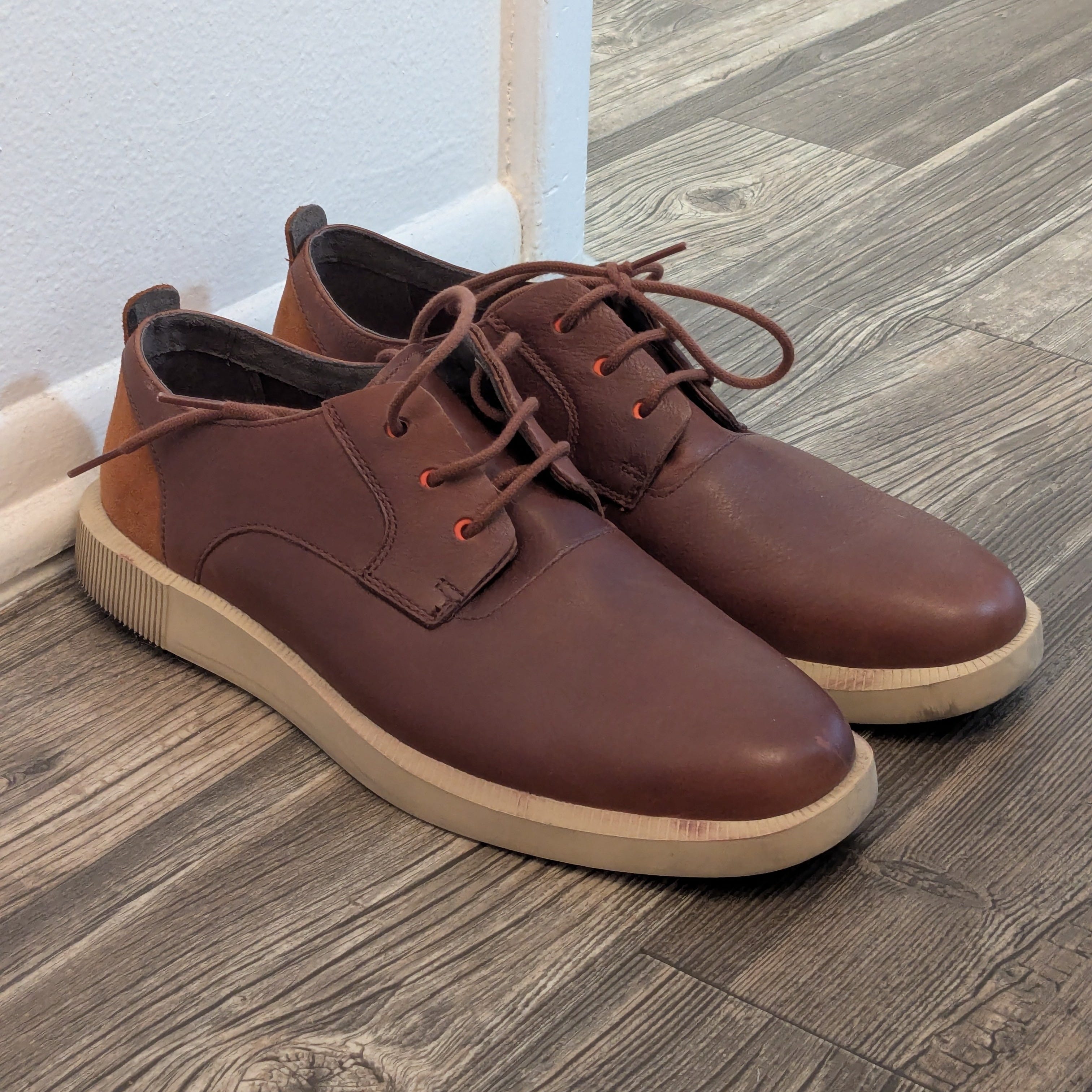
Last Friday, I was surprised to see a fine pair of brown shoes sitting on that table as well as a pile of books. The books were especially strange as my apartment building has its own modest library a mere fifteen feet from the donation table. I, of course, decided to take a closer look. Amongst the books were a few binders, some graph paper, a pair of glasses, a short USB to Micro USB cable, a manual for a TI-86 graphing calculator, and a lens that looked like it was popped out of a magnifying glass.
The books were assorted texts on church history, vocal music (operas and musicals), Roman Catholic theology, and reference material suitable for academic biblical study. There was even something from GK Chesterton—one of my favorite authors, if not my favorite author of all time. I was completely flabbergasted. Anyone who collects these types of books doesn’t ever give them away. At the very least, they don’t give them away to total strangers. Maybe, if you’re moving, you would consider giving away many of your books—only taking those you value absolutely most—but some of these books were so clearly loved and read more than once, marked with a rainbow of sticky notes which veiled and obscured the true color of the pages. As I glanced through the various tomes and volumes, I came to a simple conclusion: whoever donated these things is someone I would be immensely excited to talk to. Our interests were rather aligned: church history, music, philosophy, GK Chesterton!
As I was piling up the various books and other miscellany that I found worthwhile, I was interrupted by an old woman who lived in the building as well as the landlady. They explained to me where these items had come from.
The old man who sat in the lobby had died. These were his things. These were the things that his family didn’t care to keep or know what to do with.
I always meant to have a conversation with him.
I never will.
I didn’t know he was so interesting. I didn’t know that he was a professor. I didn’t know that he was knowledgeable in theology, church history, and vocal music.
But how could I? How could I have know that we were kindred spirits in so many ways? All I knew about him was that he was the kind old man who hung around in the lobby. Now, all I know about him now is from an archaeological perspective: these were the things he owned, this is what he spent time doing, these are the barely worn shoes he wore that fit me scarily well.
I always meant to converse with him. Anyone who spends their days in the lobby of an apartment building surely has a story to tell. Everyone has a story to tell! There isn’t a single person on God’s earth who isn’t worth talking to; everyone is worth listening to. Sure, we focus on the people who we find most interesting to listen to, most enjoyable to talk to, but everyone needs and deserves it. And no one is immortal.
I should have realized how old he was. I should’ve seen the aging look that he had—like his work on Earth was all but finished and he was simply waiting for heaven—the same look my grandma always has (though he looked a bit more patient about it).
I should have talked to him.
And I can’t stop thinking about the other people I’ve always wanted to talk to: the man on the bus who looked like if Jack Black were playing Santa Claus, the professor at my old campus who looked exactly like my best friend’s dad, the men in my community choir who scarcely have a conversation with me more in depth than “How are you?” “Fine, you?” “Fine.”
It makes me think about the conversations that will always go unhad—the conversations I would love to have had. Like with Bob Luinstra, the pastor who baptized me. Or with Dr. Ray Halm, one of the best preachers I’ve ever heard in my life. With my uncle Brad or my Uncle Bill or my Aunt Debbie. With either of my grandfathers. With my God-nephew Caleb…
Most of all, I think about the conversations I’ll never have with my dad—the ones that went unhad because I didn’t know I wanted them, didn’t know I needed them, or didn’t feel ready to have them.
I never talked with my dad about his job. Growing up, I vaguely knew he was a scientist, and later learned he worked in pharmaceutical research as a chemical engineer.
We never talked about writing music; where he got his inspiration from, how he solved being in songwriter’s block, what he thought of my own music.
Our conversation about grad school will go unhad. My dad earned a PhD and I didn’t know until his neurological disease was so far progressed he couldn’t form sentences. Even the very thought that I wanted to go to grad school didn’t cross my mind until after his death and now we can’t talk about it.
Me and my dad having a conversation about faith and spirituality? Unhad.
Our conversation about family? Marriage? Raising children? Unhad.
I’ll never be able to ask my dad for advice ever again.
So, talk to that man on the street. Listen to the old woman who lives next door. Don’t just say hello, but converse. The people around us are a treasure. Don’t let them get left behind and forgotten, only for an archaeologist to find them long after their death. Don’t let those conversations remain unhad.